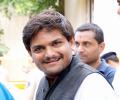
'If Haider petitions the court and the government for legitimate rights it is called minority appeasement, but when Hardik orchestrates violence he is lionised, romanticised and given huge media space that ends up both legitimising and oxygenating his movement, no matter how contrary it is to the Rule of Law,' argues Shehzad Poonawalla.

'If policy-makers hold the lives of animals to be more significant than the welfare of a human populace, I can't believe that they're likely to do anything progressive for India.'

'I have never seen anybody disliked more as prime minister than Modi.' 'What is interesting is in his prime ministership, no matter whatever happens in any corner of India, Modi is blamed for it.' 'Modi has not suspended any Constitutional liberties. No Opposition leader has been put in jail... Modi is not Hitler.'

'There are some castes that grab power, then pass on the benefits to those who belong to their own caste.'

'The real danger in India right now is that identity politics is being stoked in extremely dangerous ways.' 'The narrative you get about churches in the mainstream Indian media and the narrative you get in the social media is very different.' 'Many Americans today want to appropriate Indian culture. They want yoga, but they say yoga has nothing to do with Hinduism. They want Ayurveda, but they say it's got nothing to do with Hinduism.' 'Hinduism has been failed by political constituencies in India -- seculars and the right-wing.'

People from all walks of life and political inclinations, budding and aspiring poets and lyricists, looked at Vaali for inspiration, writes N Sathiya Moorthy.

'They must take the bull of conservatism within their own ranks by its horns as much as they need to speak out against the fallacies of the non-Hindutva (or 'Muslim-friendly') political forces as well,' argues Mohammad Sajjad.

As West Bengal, Kerala, Assam, Tamil Nadu and Puducherry prepare for new administrations, one is reminded of the disparity that runs through the veins of the Indian states, notes Mihir S Sharma.

'I believe in India people should have, up to a certain age, compulsory military training. I also believe that voting should be made compulsory. I have some violent idea, that all candidates should sign an affidavit that whatever they have promised to the people, if they are unable to fulfill they won't stand in elections again.' 'I addressed a meeting near the Kalandari mosque where more than 8,000 Muslims had come to listen to me. I said Muslims have nothing to fear, you fear only Allah. You should be afraid of no one... Some people are creating a fear about Modi in your community. I only want you to understand that.' Paresh Rawal, the BJP candidate from Ahmedabad East, speaks to Sheela Bhatt/Rediff.com

Incidents of arson, firing and vandalism were reported from Madhya Pradesh, Rajasthan, Uttar Pradesh, Bihar and Punjab as protesters agitated against the dilution of the SC/ST Act.

'Nobody is killing you in Kerala because you are Hindu unlike in North India where Muslims have been killed only because they are Muslims and were carrying some meat.'

What got the Jats of Haryana so furious?

The Magna Carta was not quite a grand demand for equality, freedoms and rule of law but just a narrow demand for restricting the ruler's powers to ring fence the interests of the elite. But its consequences greatly expanded over the centuries into a charter, which guarantees individual liberties, equality and justice to all, irrespective of race, religion and class, says Mohan Guruswamy.
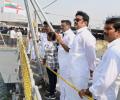
To elect, or re-elect a chief minister, the AIADMK needs to call only the MLAs for a meeting. But to elect a new general secretary, it would have to conduct direct elections with all registered cadres participating and voting. And that is just the beginning of its problems, says N Sathiya Moorthy.

'The only narrative before India is what Modi and the BJP is presenting.' 'Nationalism has been taken as a serious plank by the BJP and RSS.' 'They want to keep the nationalism thing alive to make people forget the economic reality.'
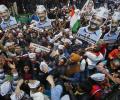
'If there is one message coming out of Delhi, it is that the country is ready for inclusive, bipartisan politics, not based on caste, community and religion, but based on issues of a modern India.'

Nathuram Godse's nephew and niece in Pune see him as a devout nationalist, not a contract killer.

'Anti-incumbency, especially in Maharashtra; the BJP's success in creating a new social coalition; and the sheer force of the party's campaign which overwhelmed its opponents,' argues Praful Bidwai, brought the BJP victory in Haryana and Maharashtra, not the Modi effect.
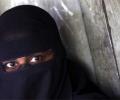
"Our only solace is that Modi will win Varanasi, but there will be a by-election here. Modi will not be able to cobble 272 seats to become prime minister so he will remain the chief minister of Gujarat. He will resign from Varanasi and then we will ensure Kerjiwal's handsome win." Rediff.com's Sheela Bhatt reports on how Varanasi's 300,000 Muslim voters are strategising their vote.

'One hopes the younger generation sees Savarkar him for what he was and does not view him through a distorted prism.' 'This is the least one could do for someone who devoted his whole life to Indian freedom struggle, elimination of caste, succour to Dalits, and instilling of strategic culture in India,' says Lieutenant General Ashok Joshi (retd) and Colonel Anil A Athale (retd).

Bring out your earthenware and clay pots, don your apron and get cooking!
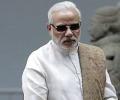
Congress leader Jairam Ramesh interacts with readers on Rediff Chat as he discusses the period that changed India's history, forever.
Anti-nuclear activist S P Udayakumar, who has been called a threat to the economic security of India by the Intelligence Bureau, speaks to A Ganesh Nadar.
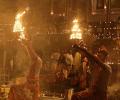
Narendra Modi has a once in a lifetime chance to change and take the RSS-BJP-VHP to a new level. Varanasi is the right place to turn the page on saffron history. By surrendering to the spirit of mystical Varanasi, Modi and his party can change the trajectory of their political journey.
.jpg)
Ayurvedic expert Dr G G Gangadharan on how the ancient Indian medical practice needs to be propagated in the country of its origin
